
The Month the Numbers Stopped Making Sense
The Calm Before the Question
By the time Renata Ibarra sat down for her monthly finance call, she had stopped taking notes. There was no longer a need. The call followed the same shape it had followed for two and a half years: her bookkeeper, Doreen, walked her through the P&L, the bank balance matched to the penny, and the two of them spent the last five minutes talking about Renata’s kids, or Doreen’s garden, or whatever Shopify app had broken that week. It was, by any reasonable definition, a good working relationship. Doreen was thorough. Doreen was patient with Renata’s questions. Doreen had never, in two and a half years, made an error that Renata could point to.
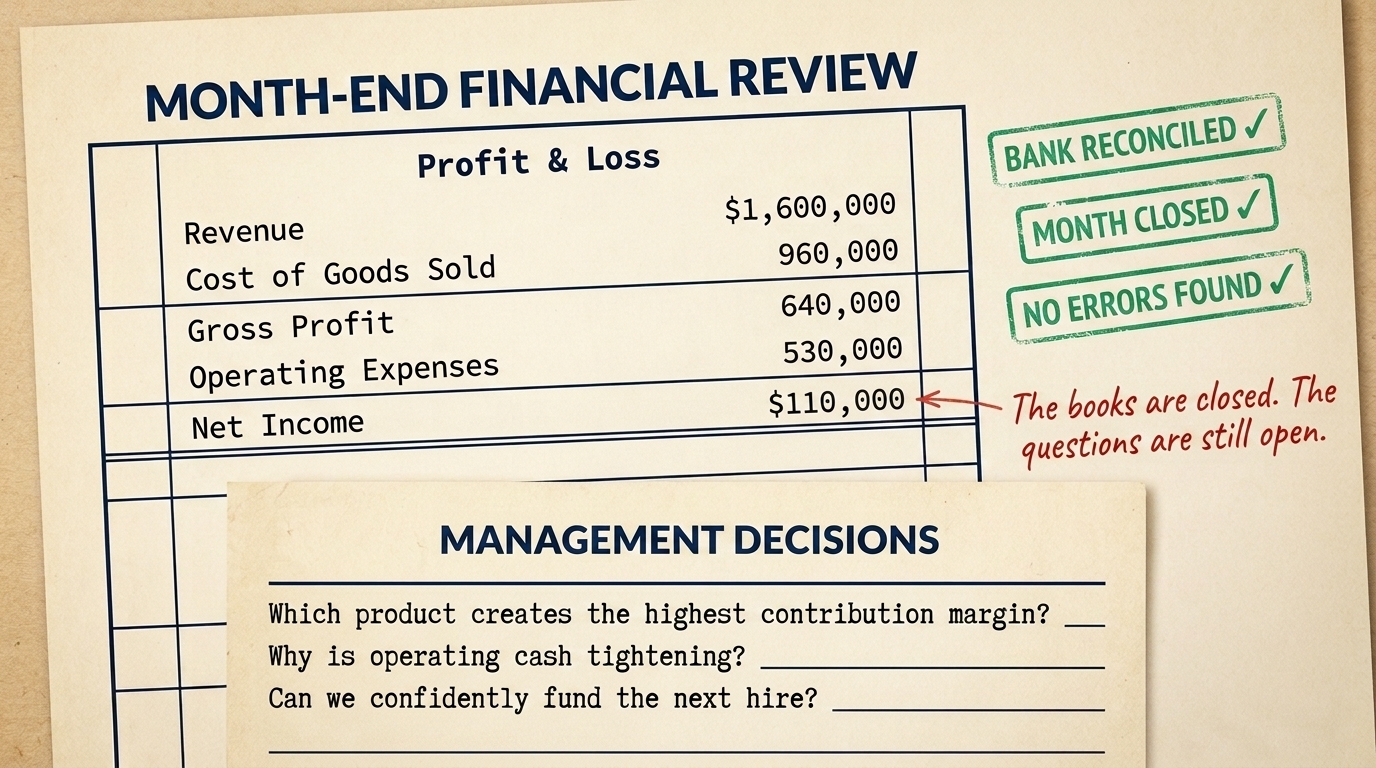
Which was exactly what made the fall of that year so disorienting. Nothing was wrong. And yet Renata kept finding herself staring at her dashboard at eleven at night, scrolling past numbers that reconciled perfectly, feeling further from the truth of her business than she had felt in her first year, when the books were a mess and she’d known it.
Renata ran a skincare brand out of a converted duplex in Austin. She’d started it selling a single fermented-rice serum to a few hundred people who found her through a friend’s Instagram story, and three years later she was doing just under six million dollars a year, shipping to four countries, and stocking a shelf at a regional grocery chain that had, against her expectations, actually taken off. The brand had grown the way a lot of good ecommerce brands grow: unevenly, in bursts, with each new channel or vendor or promotion bolted onto whatever infrastructure already existed because there had never been a natural pause to rebuild it.
Doreen had come recommended by another founder in Renata’s old co-working space, back when the business was three SKUs and a spreadsheet. She was a general bookkeeper, QuickBooks certified, careful, the kind of person who caught a duplicate vendor bill before it went out the door. For a business selling a single product through a single Shopify store with a single bank account, she had been exactly the right person. The books were clean. The taxes were filed on time. Renata had never once, in those early years, worried about whether she could trust her own numbers.
In those first months, the finance side of the business had a satisfying simplicity to it. A customer paid. Shopify deposited. Doreen recorded it. At the end of the month, Renata could look at a single number, revenue minus cost of goods minus expenses, and know, with real confidence, whether she’d made money. There was something almost meditative about it. She remembered sitting at her kitchen table with her first-ever P&L, a document Doreen had put together after just six weeks in business, and feeling a kind of pride that had nothing to do with the number itself and everything to do with the fact that the number existed at all, that her small, chaotic thing had become legible.
That legibility was, in hindsight, the thing she’d been quietly mourning all year without knowing what to call it.
How the Business Quietly Outgrew Itself
It’s worth pausing on how ordinary the growth had felt while it was happening, because that ordinariness is exactly why nobody thought to stop and rebuild anything.
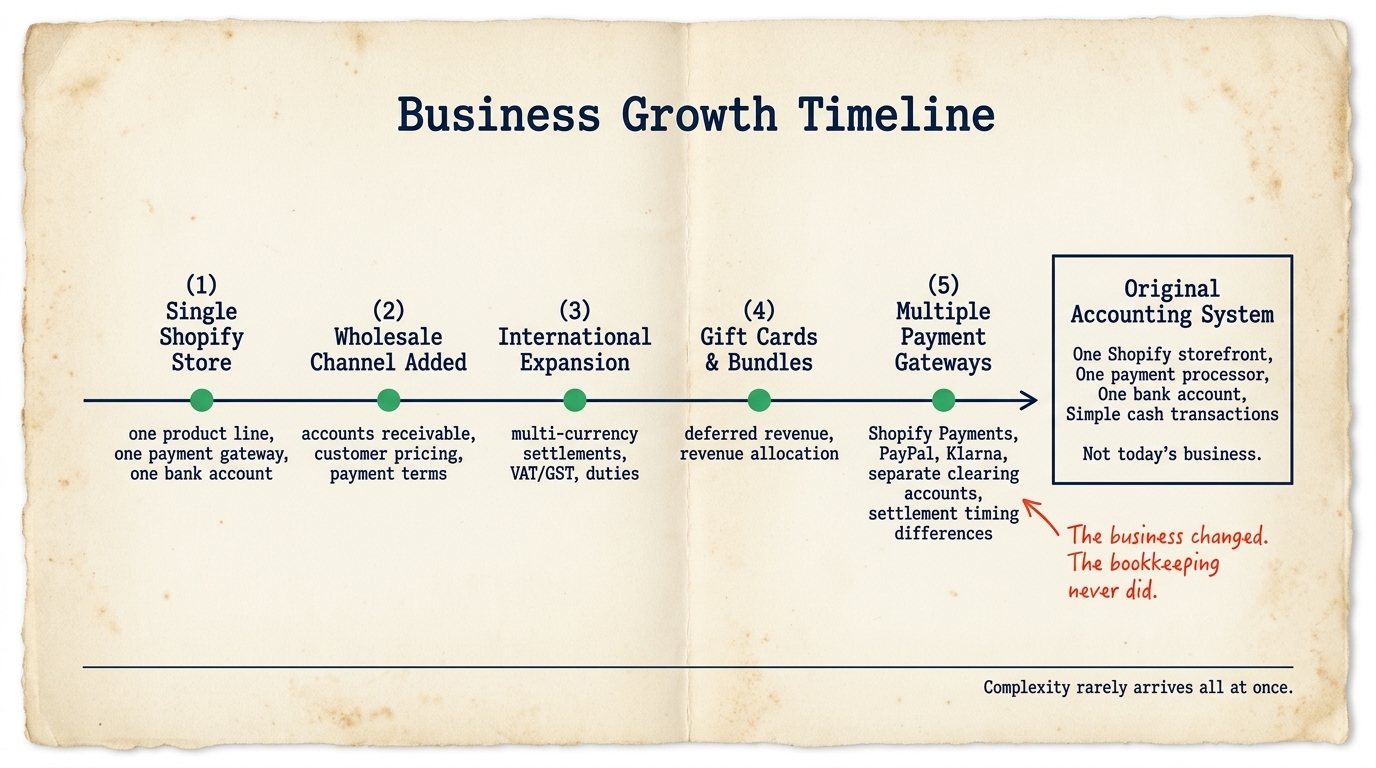
The wholesale grocery deal hadn’t been the result of a strategic plan. A regional buyer had tried the serum at a trade show, loved it, and asked for a purchase order two weeks later. Renata said yes before she’d fully thought through what wholesale accounting even required: different pricing, different payment terms, inventory that left her warehouse without a corresponding Shopify order attached to it. The international shipping hadn’t been planned either; a customer in Toronto had asked, on a whim, whether the brand shipped to Canada, and after enough of those requests Renata had flipped a switch in her Shopify settings and quietly become an international business, with currency conversion and customs duties and a whole new category of cost she hadn’t budgeted for.
Each of these moments had felt small at the time. Each of them, on its own, was small. It was only in aggregate, a wholesale channel here, a new country there, a second payment method, a promotional bundle, a gift card program added almost as an afterthought before one holiday season, that the business had become something structurally different from the one Doreen had originally been hired to keep books for. And because each change had arrived quietly, one at a time, there had never been a single obvious moment that called for a conversation about whether the bookkeeping needed to change along with it.
The unraveling, if it could even be called that, since nothing actually broke, started with a loan application.
The Loan Application
Renata wanted a line of credit to buy inventory ahead of a holiday push. Her bank was polite but specific in what it wanted: gross margin by product line, a rolling twelve-month cash conversion cycle, and a breakdown of revenue by sales channel, net of processing fees and returns. Simple enough, she thought. She forwarded the request to Doreen.
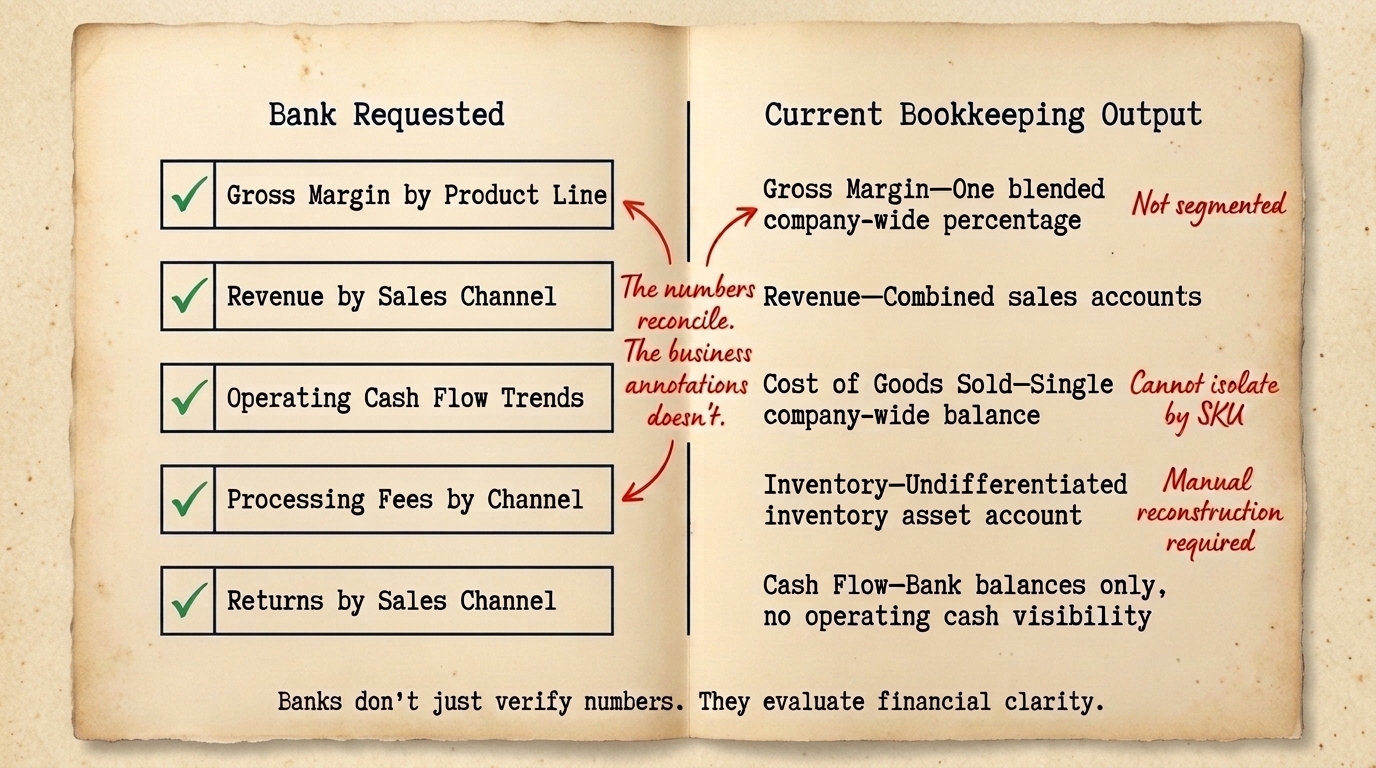
What came back three days later was, technically, everything the bank asked for. But when Renata read it, something in her stomach tightened in a way she couldn’t immediately name. The gross margin by product line was a single blended number, because the underlying COGS entries had never been split by SKU—every unit of inventory that came in the door had, for three years, hit one line called Inventory, and every unit that shipped out had hit one line called Cost of Goods Sold, with no distinction between the eleven-dollar serum and the thirty-four-dollar retinol cream that had launched the year before. The revenue-by-channel breakdown lumped Shopify, the wholesale grocery account, and Amazon into a single “Sales” figure, because the deposits from all three had always landed in the same bank account and been recorded the same way.
None of it was wrong, exactly. It was just not the shape the bank had asked for, and Renata had no way to produce that shape without weeks of manual reconstruction. She got on a call with the bank’s loan officer, hoping to explain the gap, and found herself fumbling in a way that embarrassed her more than she expected. The loan officer asked, reasonably, whether the wholesale channel carried a different margin than direct-to-consumer sales, a question Renata suspected the answer to, based on nothing more than instinct, but couldn’t actually prove, because the revenue from both channels had always landed in the same undifferentiated Sales account. She asked whether the recent freight cost increases had been absorbed into product pricing or were eating into margin, another question Renata wanted to answer with confidence and couldn’t, because nothing in her reporting isolated freight as a cost of a specific unit sold. The loan officer wasn’t hostile about any of it. She simply moved on, the way underwriters do, to a more conservative number, because uncertainty in a set of financials reads, to a bank, exactly like risk.
Renata ended up submitting a rougher version of the application than she wanted to, got a smaller line than she’d hoped for, and told herself it was a one-time inconvenience. A quirk of bank paperwork. Nothing about her actual books had changed.
Except that a question had been asked of her business that her business could not answer, and that fact sat with her longer than she expected it to.
The Payout That Never Quite Matched
The next thing she noticed, she almost didn’t notice at all.
It was a Tuesday morning ritual by then: check the bank balance, glance at the Shopify payout summary, move on with the day. For most of the business’s life, those two numbers had lined up in a way that required no thought. Money came in from customers, Shopify held it for a couple of days, then deposited it, and the deposit showed up in the bank feed and got categorized as Sales. Simple.
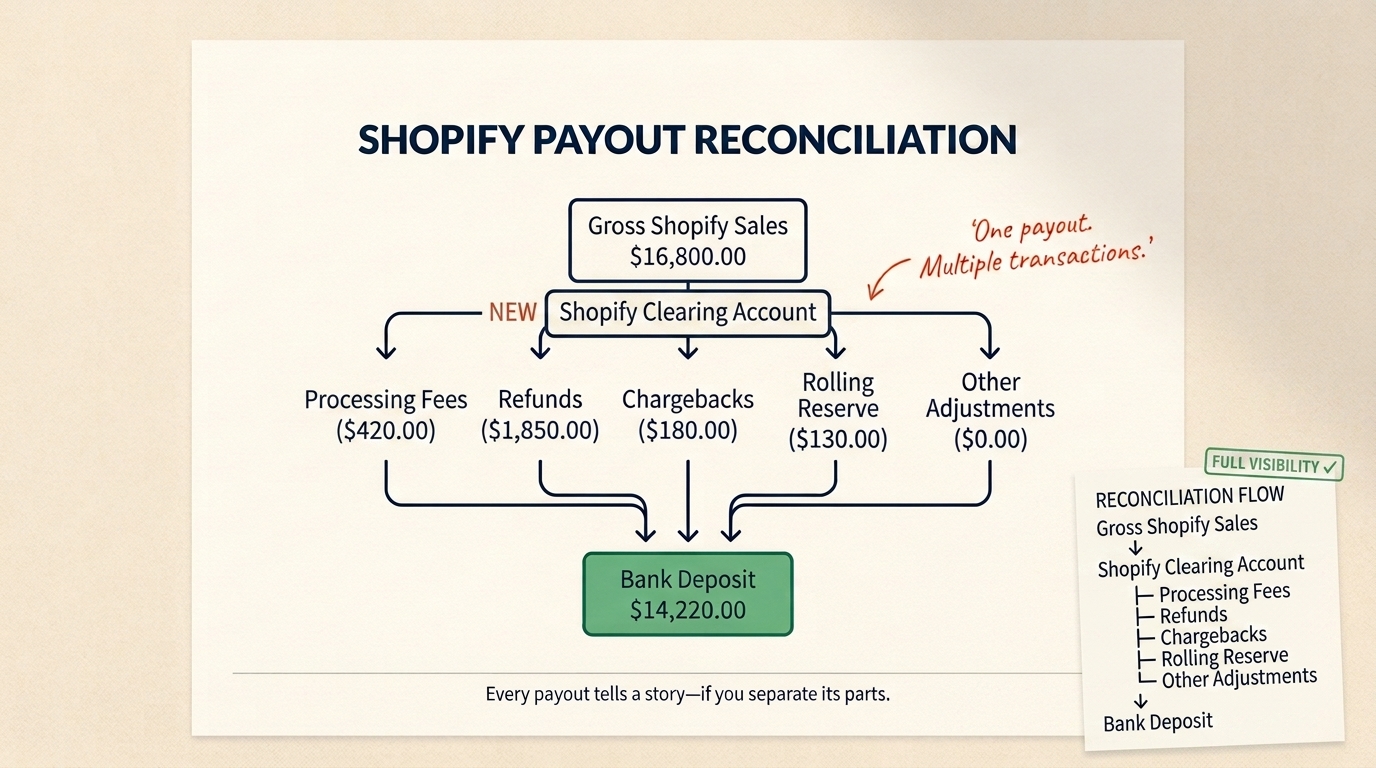
But sometime in the last year, the numbers had started drifting apart in ways that took a genuine act of attention to explain. A Tuesday deposit of $14,220 would appear in the bank, and Renata, glancing at her Shopify dashboard, would see gross sales for the relevant period at something closer to $16,800. The difference wasn’t an error. It was fees, refunds, a chargeback or two, maybe a small adjustment from a fraud dispute Shopify had resolved on her behalf. All legitimate. All explainable if you sat down and traced it. But nobody was sitting down and tracing it. The deposit simply landed in the bank feed, and Doreen’s process, a process built for a business with a single, simple revenue stream, coded the whole deposit as Sales, net of nothing, because there had never been a reason to separate the gross sale from the fees and deductions netted out before the money ever reached the bank.
The effect was subtle but persistent: Renata’s P&L was recording net Shopify payouts as if they were gross revenue, which meant her true payment processing costs, her true refund rate, and her true chargeback exposure were all quietly buried inside a single deposit figure instead of appearing anywhere she could see them. Her income statement wasn’t inaccurate. The bank still reconciled. It was just answering a much narrower question than the one she actually needed answered, which was not “did the deposit clear” but “what is this platform actually costing me, and is that cost changing?”
One night, unable to let it go, she tried to trace a single week’s discrepancy herself. She pulled up the Shopify payout report, then her bank statement, then a spreadsheet, and began matching line by line- this order, this fee, this refund, the way she imagined an accountant might. It took her almost two hours to reconcile five days of activity, and by the end of it she had the right answer, more or less, but also a headache and a creeping realization that this was not a task she could reasonably repeat every week for the rest of the business’s life. Somewhere in those two hours, buried under fee after fee, she found a small adjustment she didn’t recognize at all, a few dollars, taken by Shopify for something called a “dispute reserve,” related to a chargeback she hadn’t been aware of. It was nothing, financially. But it stayed with her, a small proof that money was moving through her business in ways she had no visibility into by default.
She mentioned the broader discrepancy to Doreen on one of their calls, half-apologetically, the way people raise things they suspect might just be their own confusion. Doreen looked into it and came back with a sensible explanation: Shopify batches multiple transactions into a single payout, nets out fees and refunds before depositing, and without a dedicated clearing account to catch that batch and break it apart, the cleanest way to book it was as a single line. It would take restructuring the chart of accounts to do it differently, a real project, not a quick fix. Renata, not wanting to make more work out of what still felt like a minor curiosity, let it go.
It was, in hindsight, the first moment the real shape of the problem was visible, if either of them had known to look for it. Doreen wasn’t wrong about how to book a Shopify payout the way she’d always booked one. She simply hadn’t built the kind of clearing-account structure that ecommerce businesses use specifically to unbundle a payout into its parts, gross sales, fees, refunds, chargebacks, reserves, because nothing in her training or her prior clients had ever required it.
Inventory and the Cost That Went Quiet
Inventory was where the drift became impossible to ignore.
Renata had always thought of her cost of goods sold as a fairly stable, almost boring number, the price she paid her manufacturer, multiplied by units sold. But her supply chain had grown more complicated than that simple formula could hold. She was now importing ingredients from three countries. Freight costs had roughly tripled since her first year, then spiked again during a shipping disruption that cost her an extra four thousand dollars in expedited air freight just to keep a bestseller in stock for the holidays. She’d started paying a customs broker. She’d absorbed a licensing fee on a new formulation. None of these costs were secret; they all showed up somewhere on the books, but none of them were making it into the cost of the inventory itself. They landed in a general “Shipping & Freight” expense line, sitting apart from Inventory and COGS, the way a smaller, simpler business’s freight costs reasonably would.
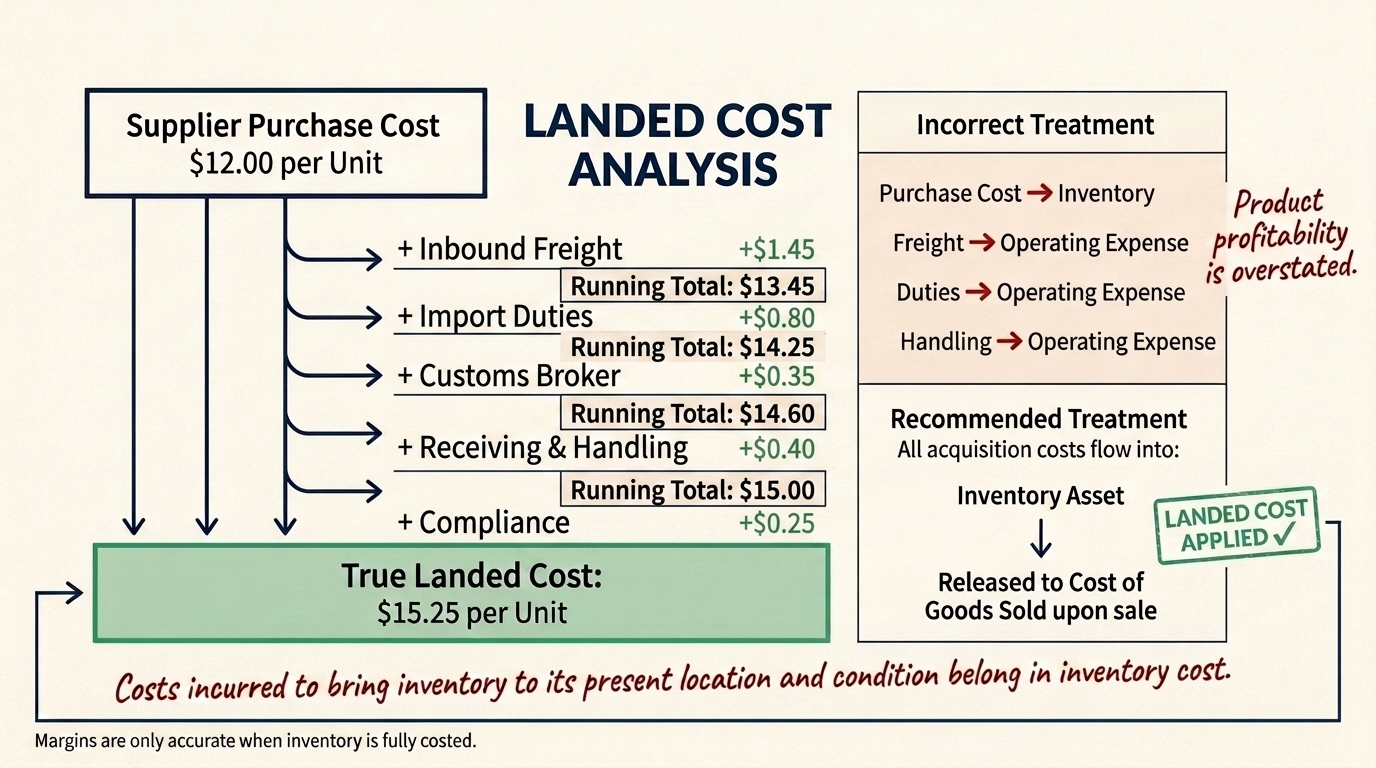
She remembered, almost fondly, how simple freight had once been: a single domestic trucking invoice, arriving monthly, small enough that expensing it directly had never distorted anything. Three years later, freight was a customs broker’s invoice in one currency, an airfreight surcharge in another, a warehousing fee for inventory sitting in a bonded facility waiting on paperwork, and a duty rate that changed depending on which ingredient triggered which tariff classification. Each of these, individually, looked like a normal operating expense. None of them, individually, looked large enough to be worth restructuring how inventory was costed. It was only in aggregate, spread silently across a P&L that had never been asked to attach these costs to the specific units they belonged to, that the truth of her margin had gone quietly invisible.
The consequence was that her gross margin, as reported, looked steady, even healthy, while her actual, true cost to land a unit of product on her shelf had crept up in ways the P&L never surfaced. She was, in effect, understating her cost of goods sold and overstating her margin, not because anyone had made an error, but because landed cost, the practice of capitalizing freight, duty, and related costs into inventory rather than expensing them as incurred, was a refinement that mattered enormously for a business importing across borders at scale, and had mattered not at all for a business ordering a single container a year from one domestic supplier.
She started noticing other things she couldn’t quite reconcile. A large inventory write-off from a batch of packaging that had arrived damaged showed up as a single expense in the month it was discovered, rather than being matched to the period the inventory had actually been consumed or discarded, which made that one month look like a bad month for reasons that had nothing to do with how the business had actually performed. A promotional bundle, three products packaged together and sold at a discount, had inventory drawn down against three different SKU costs, but the revenue was booked as a single bundle SKU, so nobody could actually see whether the bundle itself was profitable, only that inventory had gone down and a sale had come in.
The bundle, in particular, nagged at her for weeks. It had been her idea, a holiday trio of serum, cream, and cleanser, priced twenty percent below buying the three separately, meant to move slower-selling inventory alongside the bestseller. It sold well. Customers loved it. Renata assumed, the way founders often assume about their own good ideas, that it was a clear win. But when she tried to find out whether the bundle itself had actually been profitable, whether the discount had eaten more margin than the volume had made up for, she couldn’t get a straight answer out of her own books. The bundle existed as a single SKU with a single price, and the inventory drawn down against it existed as three separate cost entries that nobody had connected back to that SKU in any reportable way. She could see that inventory had gone down and revenue had come in. She could not see whether, on that specific product, she had made money or quietly lost it a little more than a thousand times over.
None of this was Doreen doing her job poorly. Doreen was doing exactly what she had always done, correctly, consistently, the same way she’d done it since Renata’s first year. The business, meanwhile, had become the kind of business where inventory accounting decisions, how you capitalize freight, how you time a write-off, how you cost a bundle, actively shape whether the numbers tell you the truth about your margins. A general bookkeeping process treats inventory as a line that goes down when you sell something. An e-commerce business at Renata’s scale needed inventory treated as a moving, multi-layered cost structure that had to be built and maintained on purpose. Nobody had ever sat down and decided to build that. It simply hadn’t been necessary until it was.
The Multiplying Ways Money Moved
The payment side of the business had quietly become its own small thicket, though it took a specific afternoon for Renata to feel the actual size of it.
In year one, there had been exactly one way to pay: a card, through Shopify Payments. By year three, checkout offered four: Shopify Payments, PayPal on its own settlement schedule, an installment plan that paid her most of the sale price up front while a buy-now-pay-later provider carried the customer’s receivable, and, for a stretch during the grocery launch, an in-store terminal running on its own timing entirely. A new hire asked her, casually, what percentage of orders were using the installment option, and whether it was actually helping conversion or just quietly shaving margin off every sale that used it. Renata realized she had no idea. The number lived on a processor dashboard that didn’t talk to her accounting software, buried inside a Sales figure that treated every dollar the same no matter what it had cost to collect it.
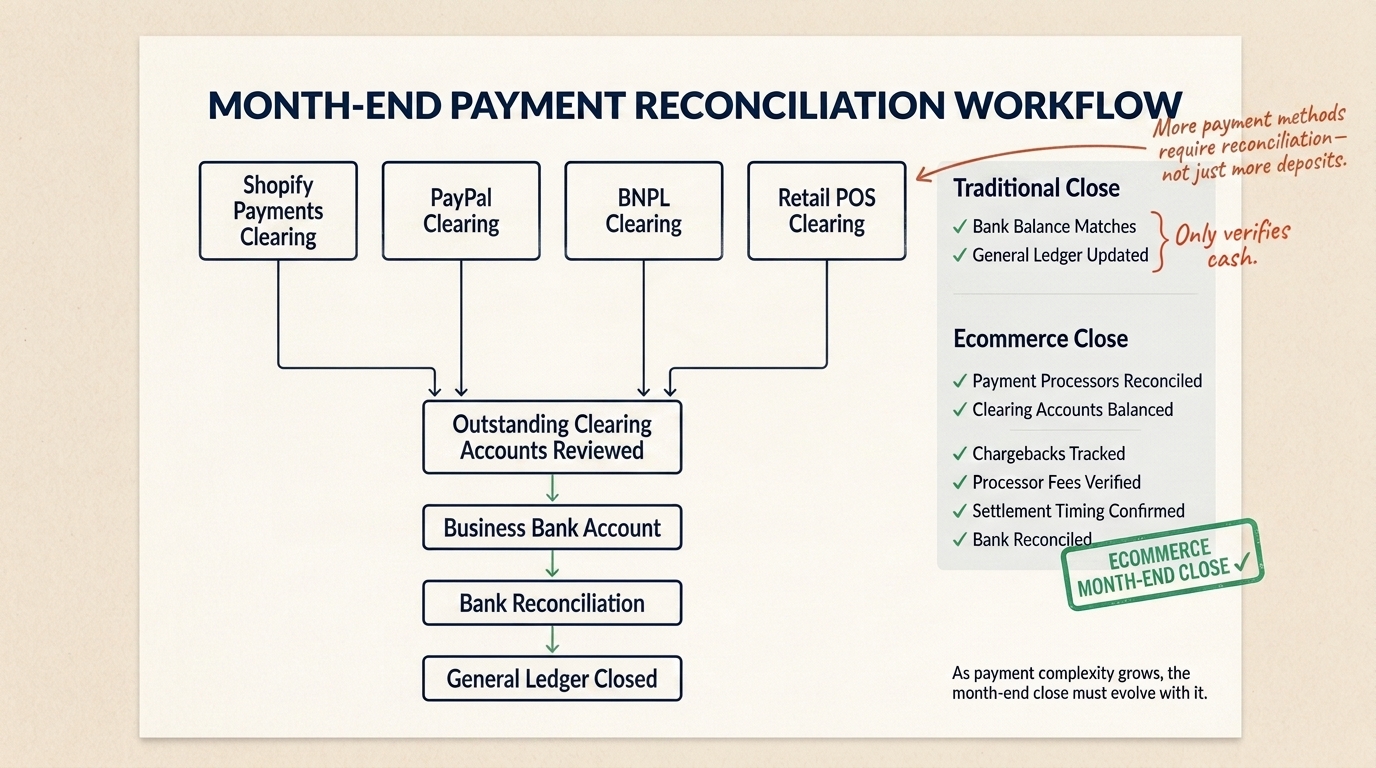
It surprised her, when she looked closer, how much the onboarding of that single installment provider had already cost in effort nobody had priced out. Reconciling its first month of deposits against actual orders had taken Doreen nearly triple her usual time; the provider’s payout report ran on its own transaction IDs and its own timing, none of it lining up cleanly with Shopify’s order numbers. Doreen got it to balance, the way she got everything to balance, eventually. But eventually was doing a lot of work in that sentence, and the manual effort required to make the books agree with reality had been quietly climbing for a year, even while the finished reports kept looking exactly as clean as they always had.
Then came the chargeback notice, not a rare event, it turned out, but the fortieth that year, a number that only startled her because she’d never seen it presented as a single figure before. Each dispute, individually, had simply left the deposit before it ever arrived, absorbed into a payout that already blended a dozen adjustments. There was no chargeback line on her P&L; there had never needed to be one, back when a chargeback was a once-a-quarter oddity instead of a running cost of doing business at scale. When she asked Doreen to tally the year’s total, it took two days to reconstruct, because nobody had ever tracked it as its own category, and the number came in high enough that Renata found herself wondering how many other small leaks were sitting inside deposits she’d been treating as gospel for years.
It was only once she held all three of these together, the untracked installment fees, the unreconciled reconciliation burden, the invisible chargeback total, that the deeper issue came into focus. The month-end close itself had never been rebuilt to catch any of it. For most of the business’s life, closing the books had meant confirming the bank balance matched the accounting software, a two-or-three-hour exercise by Doreen’s own estimate. A close for a business running four payment rails, a wholesale channel on its own invoicing cycle, and inventory split across two warehouses was not the same two-hour exercise, even though it was still being performed as if it were. The reconciliations that would have caught any of this earlier, matching Shopify’s internal reporting against what actually hit the bank, tracking chargebacks as their own category, timing the installment provider’s payouts against real orders, simply weren’t part of the original close checklist, and nobody had gone back to rewrite that checklist as the business grew past it.
What the Gift Cards Revealed
The gift cards were what finally made Renata start asking a different kind of question altogether.
The holiday season brought a modest but real wave of gift card sales, enough that, by the following February, she noticed her overall revenue for the prior December looked unusually strong, and her January revenue looked unusually soft by comparison, in a pattern that repeated itself in a way that felt less like customer behavior and more like an accounting artifact. She raised it with Doreen, more out of curiosity than concern, and the explanation she got was accurate as far as it went: gift card sales were being recorded as revenue at the moment of purchase, the same way any other sale would be.
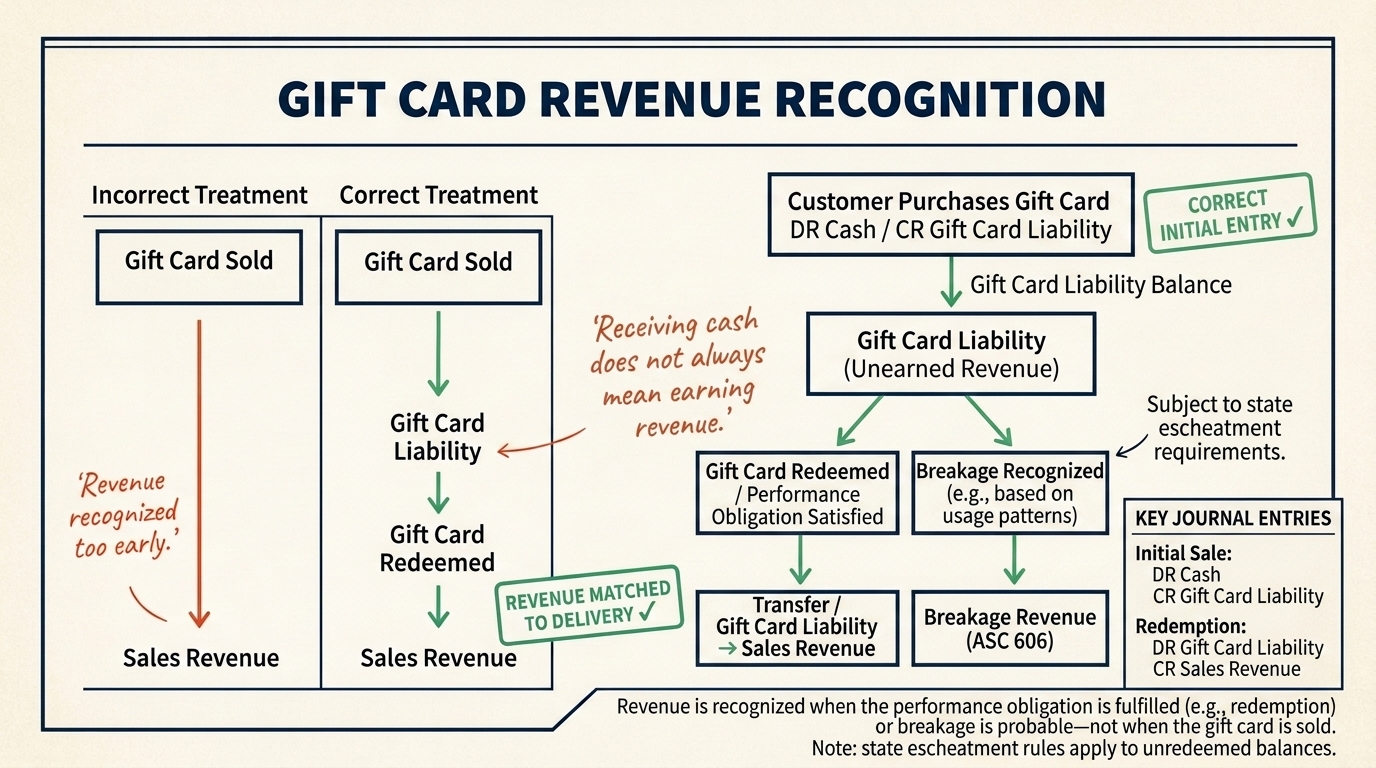
The trouble was that a gift card, properly understood, isn’t a sale at all at the moment someone buys it. It’s a liability, an obligation to provide product later, when the card is redeemed, and the revenue isn’t supposed to be recognized until that redemption actually happens. Recording it as revenue up front meant December looked artificially inflated by every gift card sold that hadn’t yet been used, and every subsequent month in which those cards were redeemed looked artificially deflated, because the “sale” had already been counted months earlier, against a product that hadn’t shipped yet.
She pulled up the numbers herself, out of frustration more than method, and found that the gap wasn’t small. A meaningful slice of December’s “revenue” was sitting, unspent, on gift cards that customers hadn’t redeemed yet, money the business had collected but not yet earned, in the strict sense, because no product had shipped against it. Some of those cards would be redeemed in January, some in March, a few, statistically, would never be redeemed at all, breakage that ecommerce businesses are allowed to eventually recognize as revenue under their own rules, on their own timeline, not the moment the card is purchased. None of that nuance existed anywhere in her books. There was no gift card liability account tracking what was owed and unredeemed. There was just Sales, a number that had already quietly counted money as earned before the business had done anything to earn it.
This one felt different from the others, and it took her a moment to understand why. The payout mysteries and the chargeback total had all been about cost—money leaving the business in ways nobody had been tracking. The gift cards were about timing: money the business hadn’t actually earned yet, showing up as if it had. It was a new kind of blind spot, not a repeat of the old one, and it made Renata wonder, for the first time, what else in her revenue might be recognized a beat too early or too late without anyone noticing.
Renata found herself doing something she hadn’t done in a long time: sitting with the P&L for an entire evening, tracing individual line items back to their source, trying to understand not whether the numbers were correct, but whether they were still measuring the things that mattered. She kept arriving at the same uncomfortable answer. They were correct. They were also, increasingly, beside the point.
The Question a Friend Asked Over Coffee
There’s a particular kind of unease that comes from being told, repeatedly, that everything is fine, while some quieter part of your attention keeps insisting otherwise. Renata had spent most of that year assuming the unease was her own fault, that she simply didn’t understand accounting well enough, that Doreen, who did understand it, must be right to treat these things as minor. It took a conversation with another founder, someone two years ahead of her with a similar-sized brand, to reframe the whole year for her.
They’d met for coffee under the pretense of talking about a shared freight forwarder, but the conversation drifted, the way these conversations do, toward the parts of the business neither of them usually said out loud. Renata found herself describing the loan application, the Shopify payout that never quite matched the dashboard, the gift card season that made December look strong, and January look strangely soft, not as a complaint, exactly, more as a list of small confusions she’d never quite resolved. The other founder listened for a while, then asked a question that stopped Renata mid-sentence: “Does your bookkeeper have any other ecommerce clients, or are you her only one?”
Renata didn’t know. She’d never asked. She realized, sitting there, that she’d never once considered it a question worth asking: Doreen was good at her job, and it had never occurred to Renata that being good at bookkeeping in general and being fluent in the specific mechanics of ecommerce might be two different things wearing the same job title.
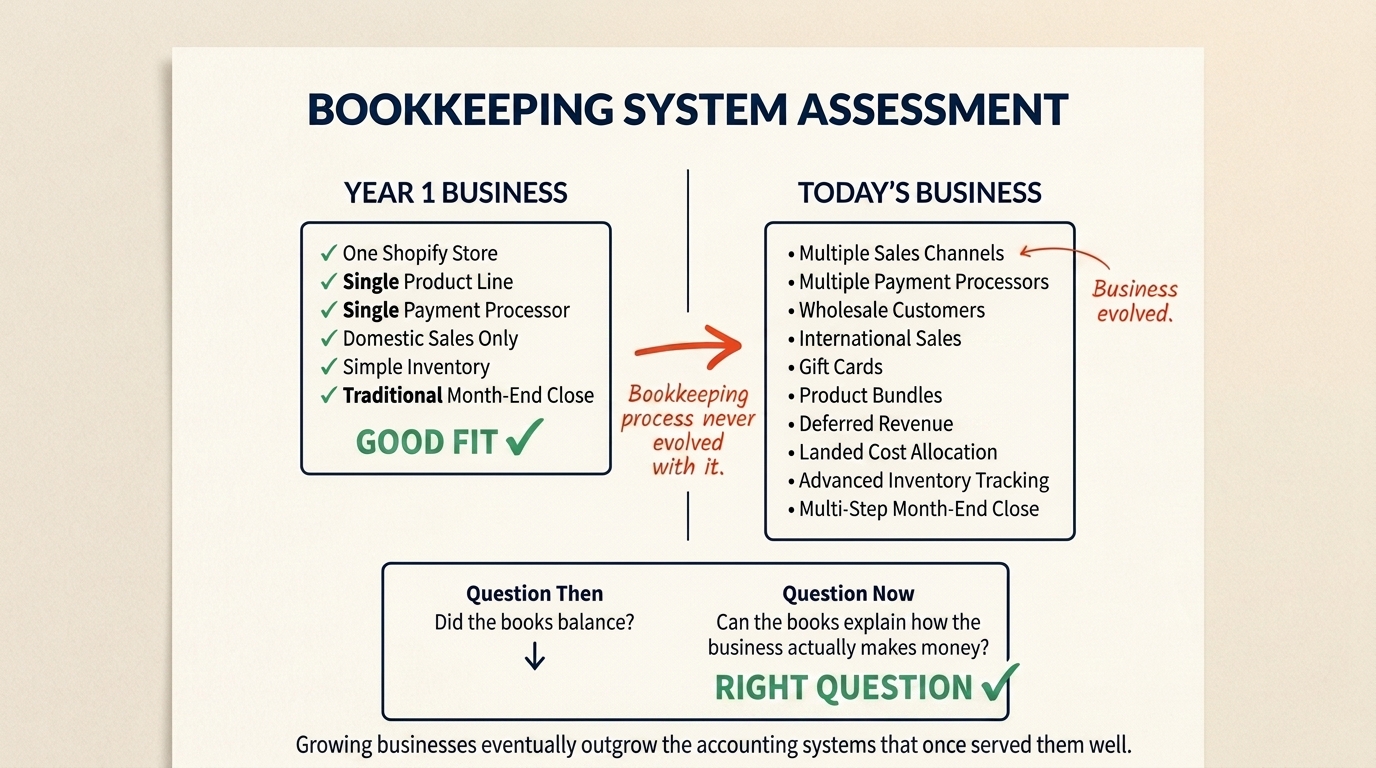
“Your bookkeeper isn’t bad,” the other founder said when Renata admitted she didn’t know. “She’s just still running the business you had in year one.”
Renata turned that phrase over for a long time afterward. It wasn’t an accusation. It didn’t require anyone to have failed at anything. Doreen had been, by every fair measure, excellent at the job Renata had originally hired her to do, a job that involved one product, one channel, one payment method, and no deferred obligations of any kind. Every choice Doreen had made along the way had been a reasonable choice for that business. The problem was that the business in front of her was no longer that business, and had not been for some time, and nobody, not Renata, not Doreen, had ever explicitly noticed the moment the fit had broken.
That was the real discovery, if it could be called that. It wasn’t that her books were wrong. It was that the questions her business now needed answered, what does each channel actually cost to serve, what is my true landed cost per unit, how much of my reported revenue is actually still obligated to a customer who hasn’t received anything yet, were questions a general bookkeeping process had never been built to ask, because for most of Renata’s history, those questions hadn’t existed yet either.
The Research Weekend
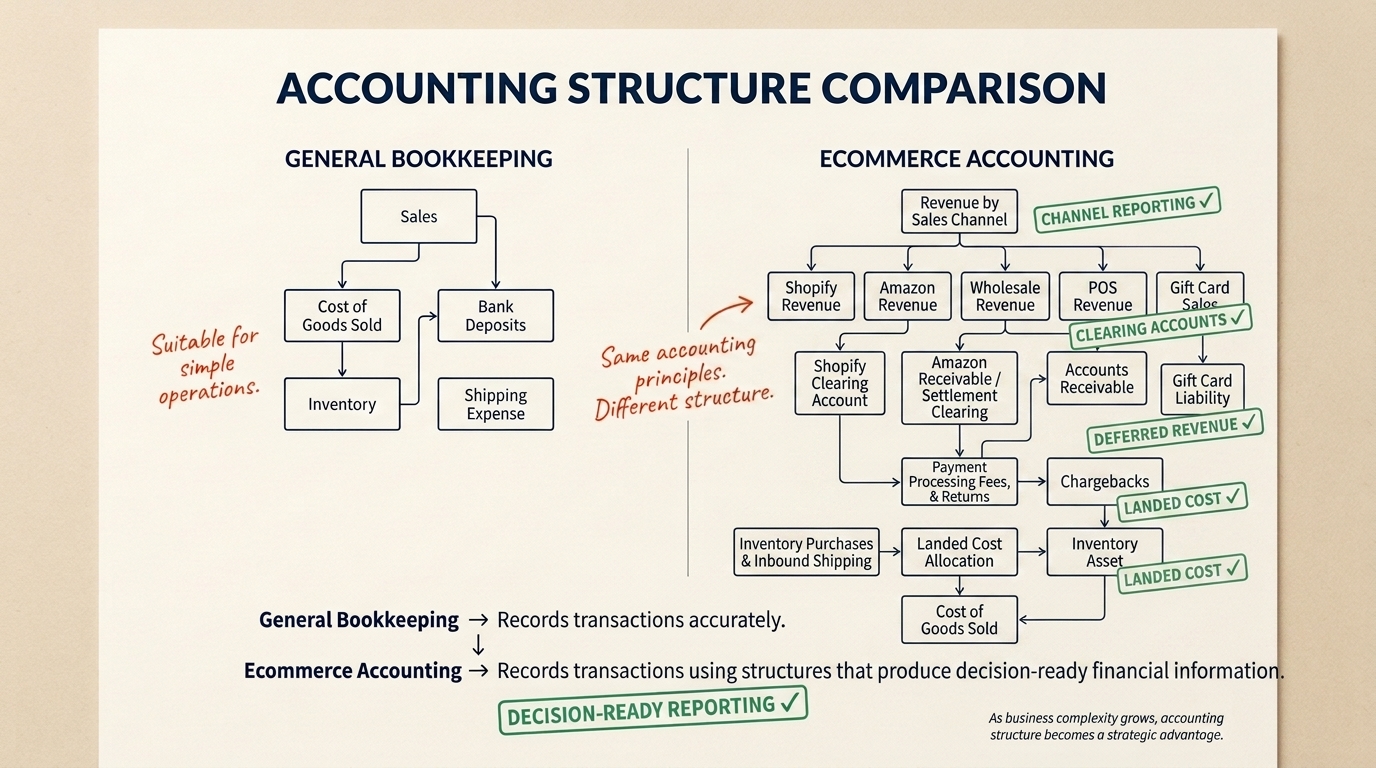
Curiosity got the better of her before resignation did. She spent a weekend doing what she probably should have done a year earlier, reading about how ecommerce businesses her size actually structured their books, not because she distrusted Doreen, but because she wanted to know what she didn’t know. It was a strange kind of research, quietly humbling. She learned that a properly built clearing account structure would have caught every one of the Shopify payout mysteries automatically, breaking a single deposit into gross sales, fees, refunds, and reserves the moment it landed, so that “what did this platform actually cost me” became a number you could read off a report rather than a question you had to reconstruct by hand at eleven at night. She learned that landed cost wasn’t an exotic technique reserved for large importers, but a fairly standard practice the moment a business crossed a border more than occasionally, one that would have kept her gross margin honest instead of quietly overstated. She learned that a chart of accounts built for ecommerce specifically tends to separate revenue by channel almost as a matter of habit, not because any one channel is more important, but because a founder making decisions needs to know which parts of the business are actually carrying the weight.
None of it read as an indictment of Doreen. If anything, it read as a kind of relief, proof that the discomfort she’d been sitting with all year had a name, a known shape, a whole body of practice built specifically around the problem she’d been quietly living inside of. She wasn’t confused. She wasn’t bad at understanding her own business. She had simply been reading reports built for a business one or two sizes smaller than the one she now ran, and no amount of squinting at them harder was going to make them answer questions they weren’t built to answer.
She thought about the founder who’d asked her, over coffee, whether Doreen had other ecommerce clients, and about how differently that single question had reframed a year’s worth of low-grade unease. It wasn’t really a question about Doreen’s competence. It was a question about specialization, about whether the person keeping her books had ever had reason to build the specific muscles her particular business now required. A general practitioner and a cardiologist can both, honestly, be excellent doctors. You only need to know which one you’re sitting in front of when the question at hand is your heart.
What Renata Understood, in the End
Renata didn’t fire Doreen. That was, in some ways, the hardest part of the whole realization to sit with; there was no villain in the story, no negligence to point to, nothing that made the decision feel clean. Doreen had done the job she’d been asked to do, faithfully, for three years, and had done it well. What Renata was starting to understand was that the job itself had quietly changed shape underneath both of them, and that the skill required to keep pace with a multi-channel, multi-currency, inventory-heavy ecommerce business, the specific fluency in Shopify payout mechanics, in landed cost, in deferred revenue, in the accounting choreography of chargebacks and BNPL settlements and gift card liabilities, was not a deficiency in Doreen. It was simply a different specialization, one that general bookkeeping, however careful, had never claimed to offer.
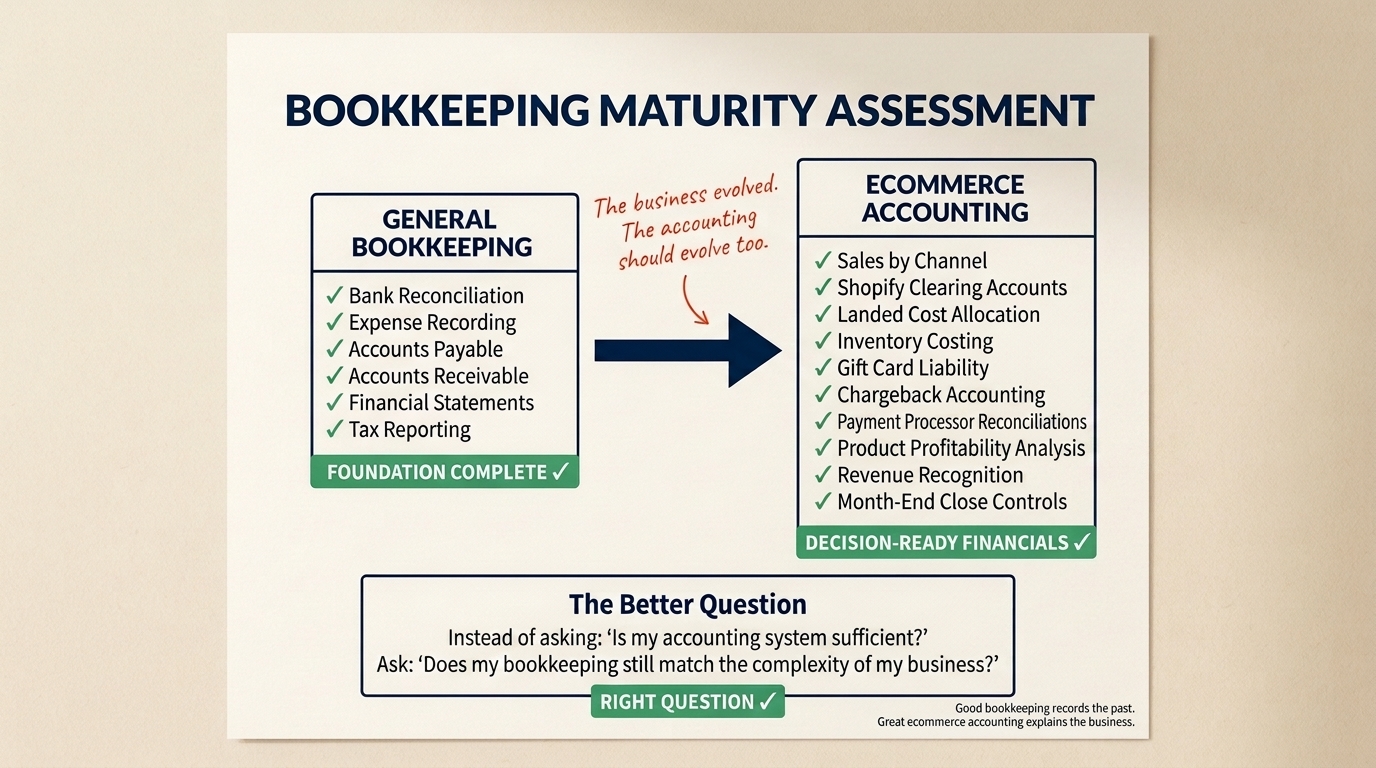
She thought, more than once in the weeks that followed, about how easy it would have been to keep going the way things were. The books reconciled. The taxes got filed. Nothing was on fire. It would have been simple to decide that “nothing is technically wrong” was the same as “everything is fine,” and to keep having the same calm, pleasant monthly call for another three years.
What she couldn’t stop thinking about, in the end, wasn’t any single missed number. It was the loan application. It was the fact that when her business had been asked, directly, to describe itself, its margins by product, its true cost by channel, its real revenue net of every fee and obligation, it hadn’t been able to answer. Not because the business was doing badly. Because nobody had ever built a way to speak that language.
She still didn’t know, by the end of that year, exactly what came next, whether that meant a new bookkeeper, an ecommerce-specific accounting firm, or some hybrid arrangement that kept Doreen for the parts of the job that hadn’t changed and brought in specialized help for the parts that had. Doreen, when Renata finally worked up the nerve to have the conversation honestly, took it better than Renata expected, with something closer to relief than defensiveness, as if she too had sensed for a while that the fit had shifted without either of them naming it. “I’ve been wondering if you needed something I don’t do,” Doreen said, and the plainness of it made Renata like her more, not less.
What Renata did know, by then, was that the question she’d been asking all along- is my bookkeeper good- had been the wrong question from the start. Doreen was good. She had always been good. The question that actually mattered, the one Renata wished she’d learned to ask two years earlier, was whether the bookkeeping itself had kept pace with the business it was supposed to describe. And somewhere between the loan application and the gift card season and the two-hour night spent reconciling five days of Shopify payouts by hand, she had stopped being able to pretend she didn’t already know the answer.
The Pattern Behind Every Founder’s Version of This Year
What stayed with Renata longest wasn’t any single number, in the end. It was how long she’d mistaken specialization for a solved problem, how easy it had been to assume that because her books had always been accurate, they must also still be complete, and how different those two words turned out to be once her business had grown past the point where accuracy alone was enough. Accuracy had never been the issue. Doreen’s numbers were correct on every call, every month, for three straight years. What had quietly slipped was completeness, whether those correct numbers were still being asked and structured to answer the questions a business at Renata’s size actually needs answered.
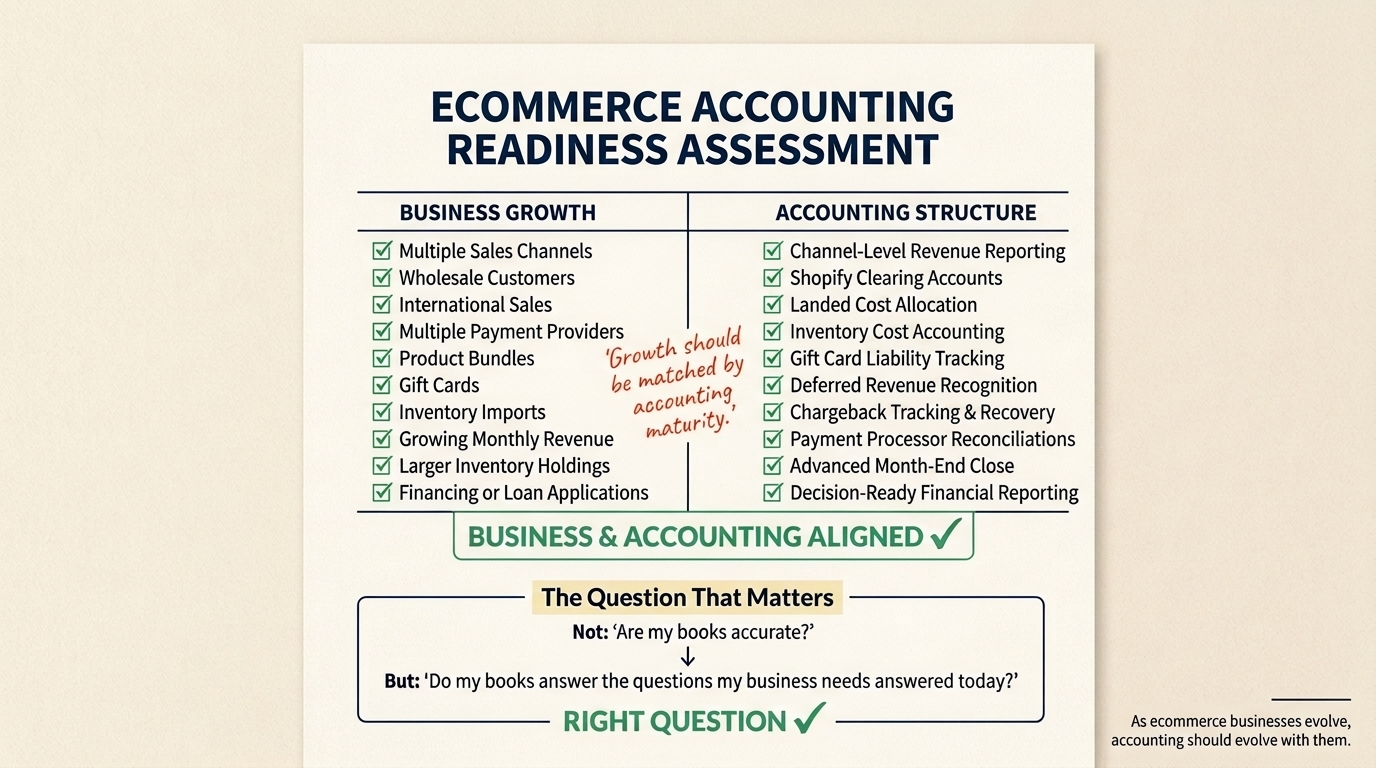
If any part of Renata’s year sounds familiar- the reports that reconcile but no longer quite explain, the Shopify payout that never matches the deposit, the margin that looks steady while the freight bill quietly climbs, the gift card season that makes one month look strong and the next look strangely soft- it’s worth asking the question she eventually asked herself. Not whether the bookkeeper is doing a good job. Whether the bookkeeping was ever built for the business now running through it.
Most founders don’t wake up one morning needing ecommerce-specific bookkeeping. They arrive there gradually, the same way Renata did. One wholesale customer. One new country. One payment processor. One warehouse. One gift card program was added almost as an afterthought before the holiday season. Each addition is reasonable on its own, small enough to absorb without a second thought. By the time the need for something more specialized becomes obvious, the business has usually been quietly evolving past its bookkeeping for months, sometimes years, one ordinary decision at a time.
GreenTarget works with Shopify founders to answer exactly that question—reviewing existing books against the realities of modern ecommerce accounting, and identifying, plainly, where a business may have outgrown the system keeping its books. If you’re not sure whether your reports still answer the questions your business actually needs answered, that’s a conversation worth having before the next loan application, the next holiday season, or the next quiet month that doesn’t quite add up.