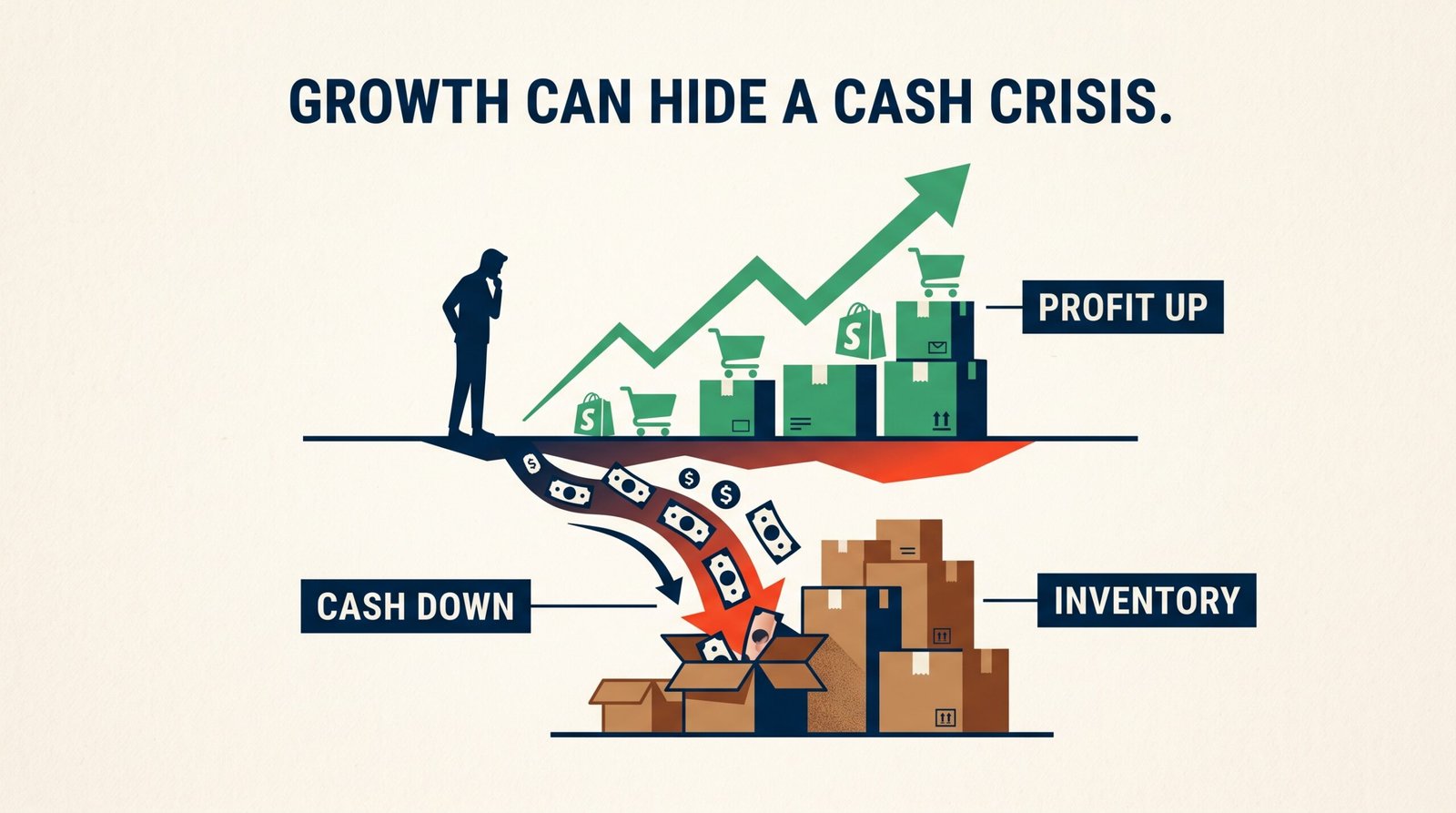
Why a Shopify Business Can Be Profitable and Still Run Out of Cash
Here is one month for a hypothetical Shopify brand.
Revenue | $100,000 |
Cost of goods sold | −$40,000 |
Advertising | −$20,000 |
Fulfillment and fees | −$15,000 |
Other operating expenses | −$10,000 |
Profit | +$15,000 |
It’s a good month, with healthy sales and margins that hold up. The profit-and-loss report shows $15,000 of profit.
Then the founder checks the bank balance. Cash went down by $15,000.
Profit: +$15,000. Cash: −$15,000.
If the business made money, where did the cash go?
That contradiction is more common than it first appears. The numbers can all be accurate, and the business can still feel short of money.
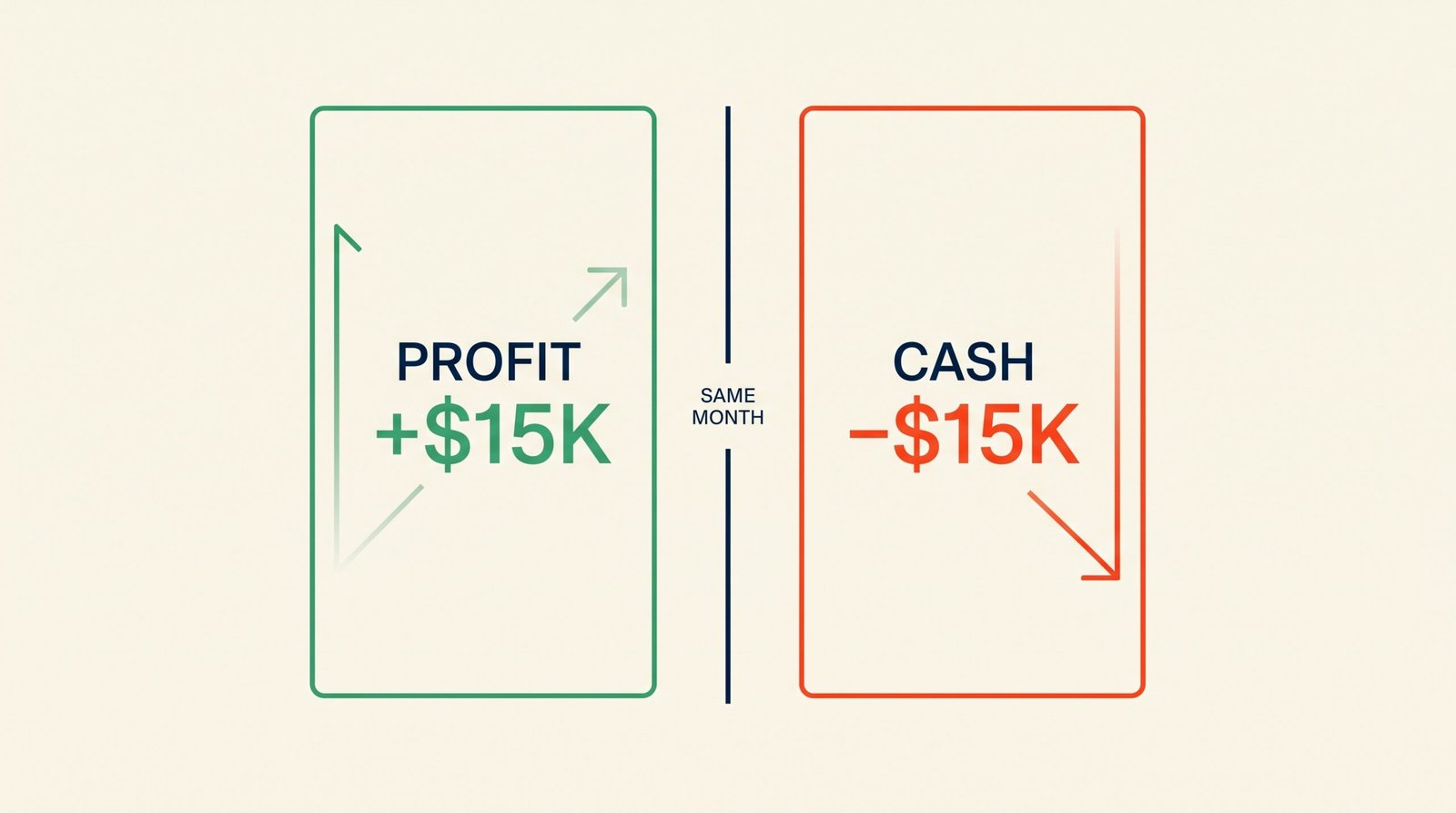
A Profitable Month Can Still Be a Cash-Negative Month
To see the gap, look at the same month from the bank’s side. Assume every dollar of that revenue reached the bank during the month, and that the $40,000 of product sold was paid for in an earlier month. This month also included one large payment: $70,000 to restock inventory.
Cash in from sales | +$100,000 |
Advertising | −$20,000 |
Fulfillment and fees | −$15,000 |
Other operating expenses | −$10,000 |
Inventory restock | −$70,000 |
Change in cash | −$15,000 |
The two views differ in one line. The profit report charged the business $40,000 for the product it sold this month, while the bank paid out $70,000 for the product it bought.
The difference is $30,000, and it didn’t leak anywhere. The business spent $70,000 on stock, only $40,000 of stock left the shelf as sales, and the shelf is now $30,000 heavier.
Profit asks whether the business earned more than the goods and costs consumed by this month’s sales. Cash asks what the business can spend on Monday morning. A growing business can answer yes to the first and not much to the second. Both answers can be correct: the profit is real, the books can be accurate, and the cash pressure is real too.
The missing money went into stock.
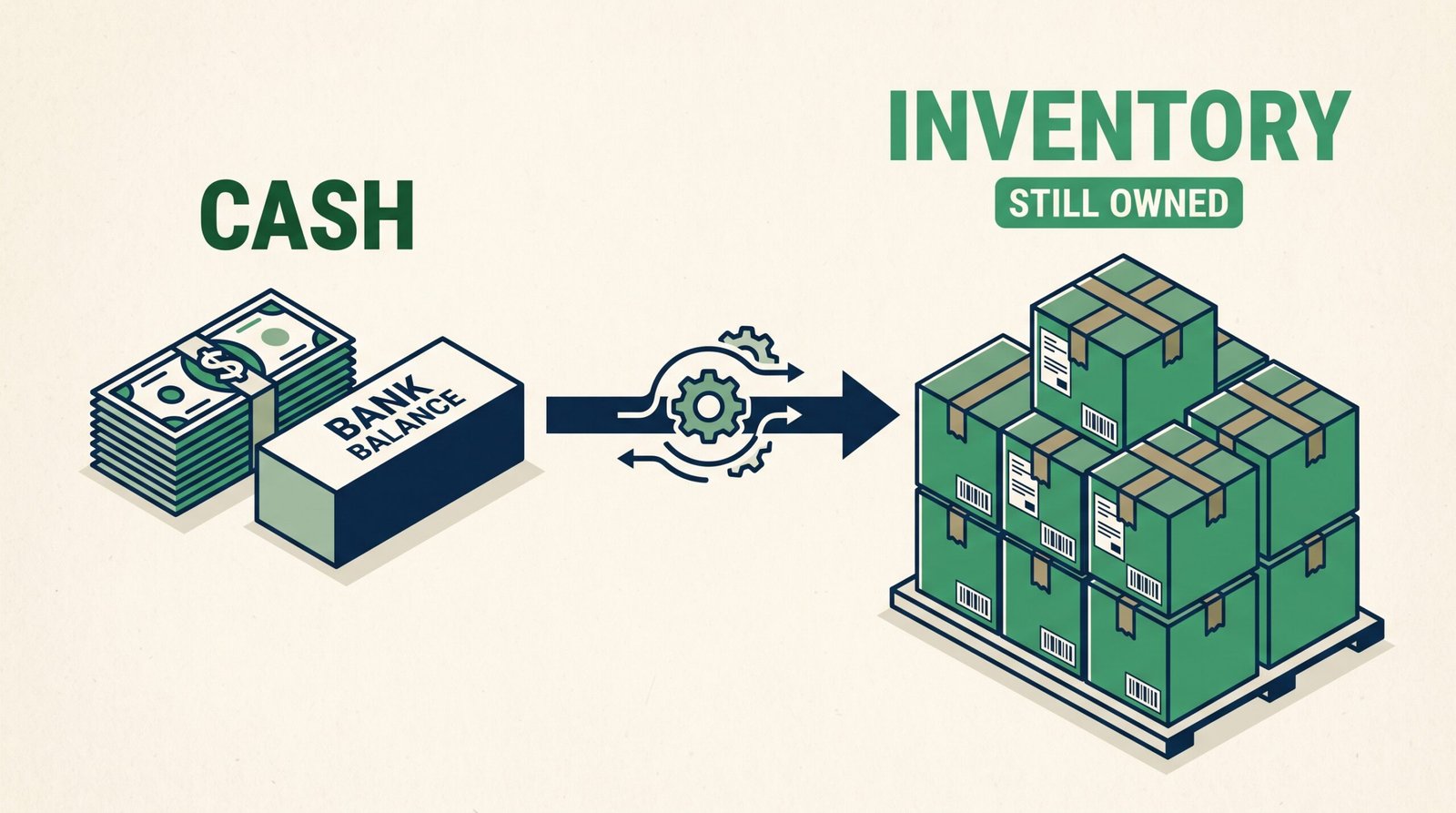
Inventory Is Cash in Another Form
Inventory is cash you’ve turned into stock.
You can spend $70,000 on inventory this month without creating a $70,000 expense on this month’s profit report. The cash has left the bank and the stock is still here. Its cost reaches the report only as those units sell. Until then the money is sitting in a warehouse, on a supplier’s production line, or on a boat.
Unsold inventory isn’t a loss or an error. It’s property the business owns, and it turns back into cash as it sells. The margin determines how much value those sales ultimately create, but the timing of the return is set by customers, while the bills arrive on the supplier’s schedule.
Cash tends to leave in stages, and several of them happen before any product can sell:
- Supplier deposits. Many manufacturers ask for a deposit when the order is placed, so cash goes out before a single unit exists.
- Balance payments. Sourcing guides commonly describe a deposit up front and the balance before shipment or against shipping documents, though terms vary by supplier and are negotiable.
- Freight. Getting stock to where it can be sold is its own bill.
- Duties, customs, brokerage, and tariffs where applicable. For imported goods, these can also require cash before the inventory generates sales, and the amount may not be fixed on the day the supplier is paid.
Each one commits cash before the product earns anything. Buying the inventory is only the start. What matters next is how long it takes for that cash to come back.
Follow One Dollar Through the Shopify Cash Loop
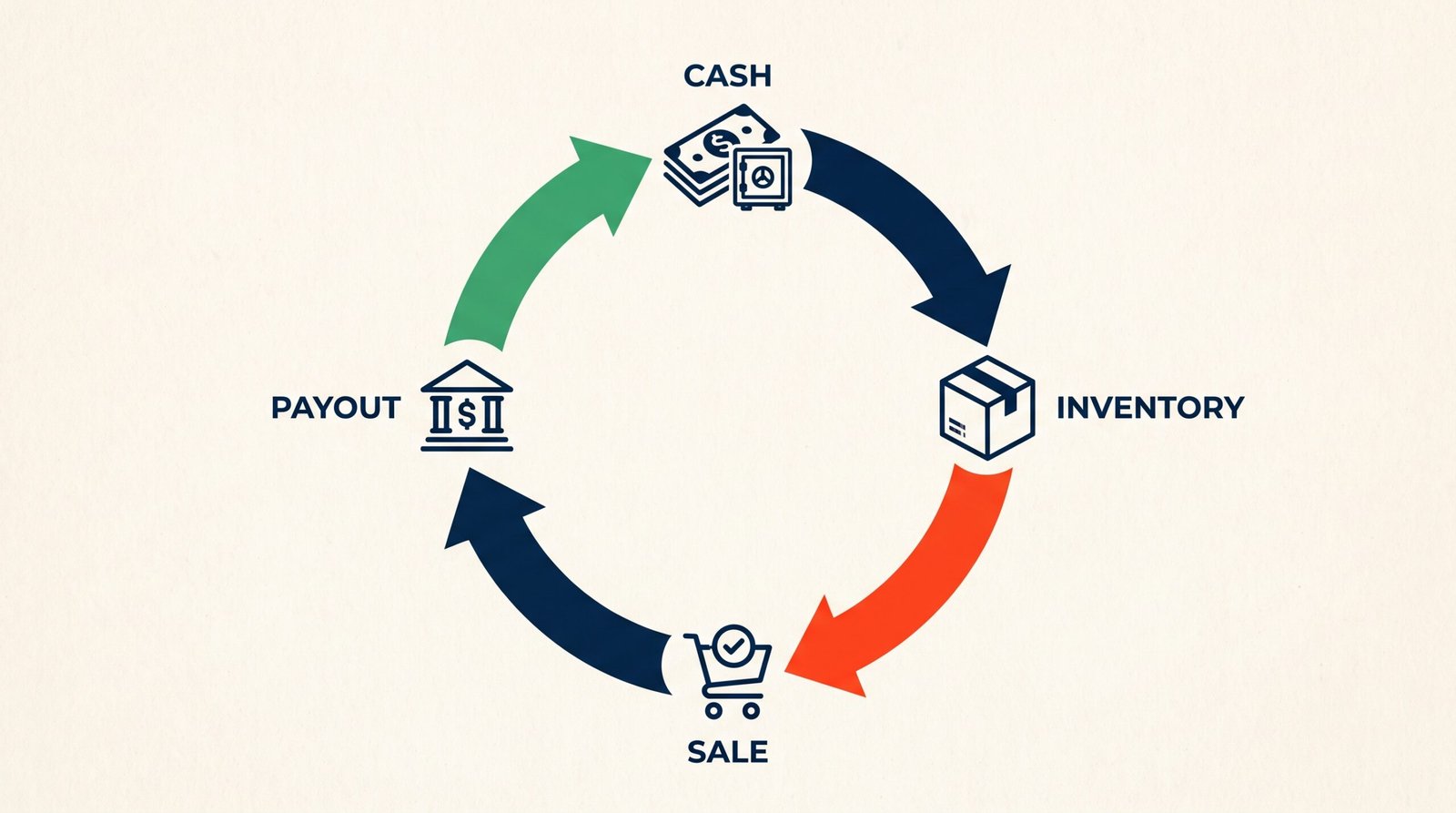
Think of the business as a loop that cash travels around:
Cash → Inventory → Sale → Payout → Cash
A dollar leaves the bank as a supplier deposit or inventory payment. It becomes goods in production, then goods in transit, then inventory available for sale. A customer places an order and Shopify captures the payment. The money settles, gets paid out, and lands in the bank. Only then is it spendable again.
The founder’s real question is how long that dollar is away.
Take a hypothetical purchase. A brand orders $90,000 of goods, with $6,000 of freight and $9,000 of duties and related fees. All of these figures are illustrative.
Deposit when the order is placed (30%) | $27,000 |
Balance before shipment | $63,000 |
Freight | $6,000 |
Duties and import fees | $9,000 |
Cash committed before the first sale | $105,000 |
The goods still have to arrive, clear customs, be received at the warehouse, and go live for sale. Only then do customers start buying, and only after that does the first payout make its way back.
By the time the first dollar returns, $105,000 has already gone out. None of that inventory cost has reached cost of goods sold yet, because none of the inventory has sold.
How long does the whole loop take? There’s no universal answer. It can run from weeks to months, depending on supplier terms, production time, the freight route, customs, warehouse receiving, how quickly the product sells through, and payout timing. The sequence above shows the shape of the loop, not a benchmark for any business.
Even the last step takes time. Shopify’s Help Center describes a minimum settlement period between a payment being captured and the funds becoming available to pay out. For US merchants the minimum is three business days, and banks can need another one to three business days after the payout is sent. Country, risk level, payment method and payout schedule all change the timing. The wait is measured in days, not months, but each of those days can represent sales already showing in the business’s reporting while the cash is still on its way to the bank.
Finance teams call the length of this loop the cash conversion cycle. In founder terms, it’s how many days your cash is out before it comes back.
Why More Sales Can Require More Cash
This is where the contradiction stops being a one-month oddity.
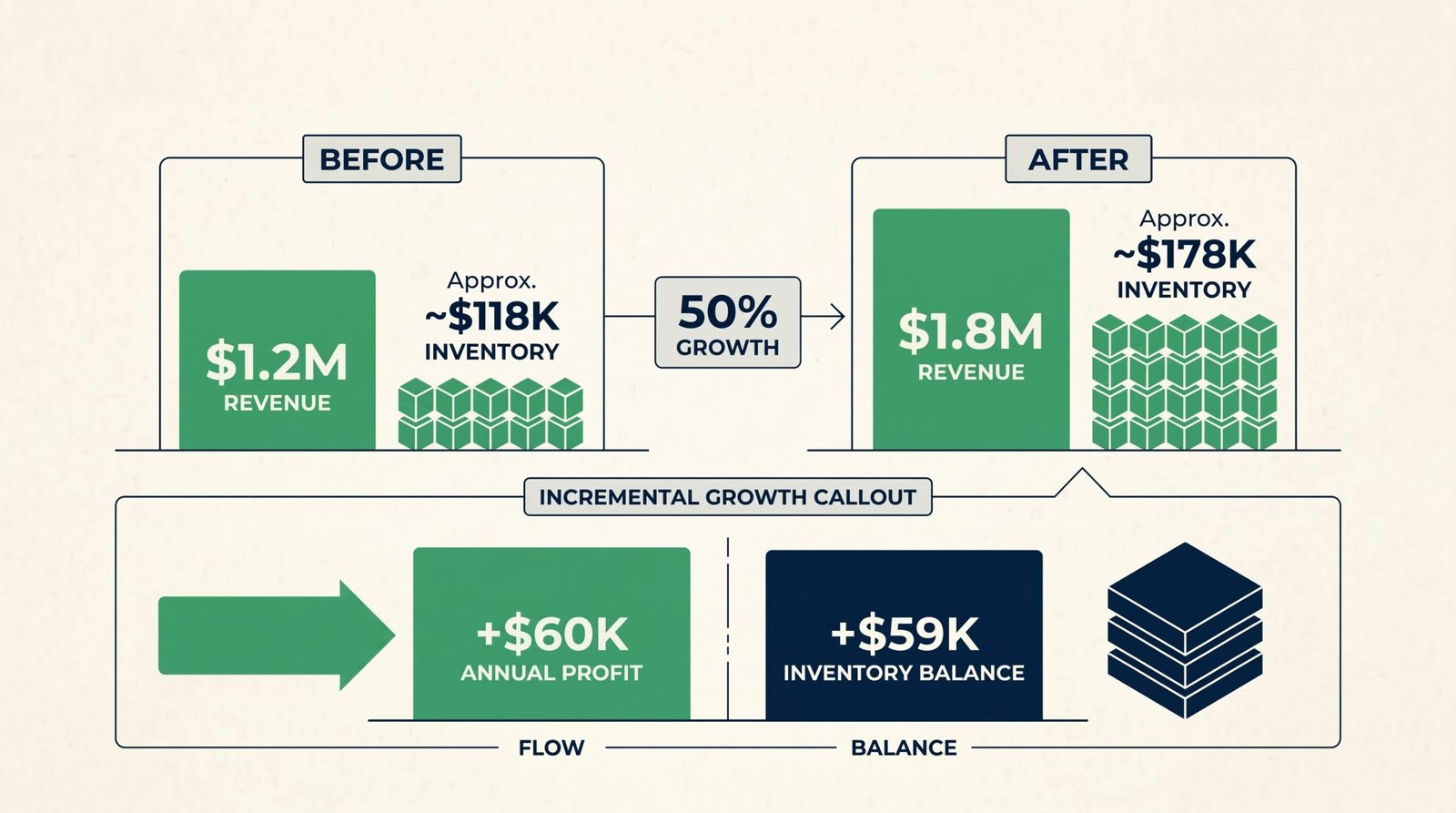
Suppose a business holds about 90 days of inventory, enough stock to cover roughly three months of sales at cost. The dollar value of that stock depends on how much product the business sells. Here is a simplified hypothetical.
The business today
- Revenue: $1,200,000
- Cost of goods sold: $480,000
- Net profit: $120,000
- Inventory held: 90 days
At $480,000 of annual product cost, the business goes through roughly $1,315 of stock a day. Ninety days of that is about $118,000 of inventory, which is the cash sitting in stock at any given time to keep the business running.
The same business after 50% growth
- Revenue: $1,800,000
- Cost of goods sold: $720,000
- Net profit: $180,000
- Inventory held: still 90 days
Now the business goes through about $1,973 of stock a day. Ninety days of that is about $178,000.
The business got bigger and more profitable. Annual profit rose by $60,000. But holding the same 90 days of stock now takes roughly $59,000 more cash to stay invested in inventory.
Those two numbers shouldn’t be subtracted from each other, because they’re different kinds of numbers. The $59,000 is a balance, an added amount that has to remain in stock for the business to operate at the higher sales level. The $60,000 is annual profit, earned gradually over twelve months.
Still, the comparison shows scale. Supporting the higher sales level takes roughly $59,000 more cash to remain invested in inventory capacity, and that’s nearly as large as the whole $60,000 increase in annual profit. Growth can require almost a full year of incremental profit to stay invested in additional inventory.
This example is deliberately simplified. It leaves out what suppliers let you pay later, money customers owe you, payout timing, seasonality, taxes, financing, and purchases made through the year. Its job is to show why the cash requirement rises with sales.
It also explains how revenue is up, profit is up, and cash pressure is up, all at once. Growth increases the amount of cash the business has to commit before the profit it creates becomes spendable. A profitable Shopify business has to pay for its next round of stock before it can spend the profit from the last one, and growth makes that round bigger.
Three ways this happens in an inventory business:
Bigger purchase orders. A larger order means a larger deposit and a larger balance payment. Sometimes a supplier’s minimum order quantity pushes the order above what near-term demand calls for, so more cash sits in stock for longer.
Overlapping inventory cycles. Growing brands rarely wait for one order to sell through before placing the next. The next deposit goes out while the last purchase is still on the shelf, so the business is funding two or three rounds of stock at once.
Seasonal builds. A business preparing for its peak buys stock months ahead, and often ramps advertising before the revenue arrives. The cash requirement peaks before the revenue does.
Other Places Profitable Cash Can Get Stuck or Leave the Business
Payout timing. A sale appears in your sales reporting right away, while the money moves through settlement, payout and bank processing. At month-end, some recent sales can still be on their way to the bank.
Reserves, refunds and disputes. Shopify Payments can place a reserve on part of your payouts, as a percentage or a fixed amount for a set period, to cover refund and dispute exposure. Shopify’s documentation lists elevated refund rates and sharp volume surges among the factors that can lead to one. The sales were real, but that portion isn’t spendable until the reserve is released. Refunds come out of the next available payout. When a customer files a chargeback, the disputed amount is withdrawn at filing and returned only if the merchant wins. A strong promotion can therefore be followed by a lean payout period, even though the original sales were genuine.
Wholesale receivables. If you also sell wholesale, the same loop gets one extra step:
Cash → Inventory → Sale → Receivable → Customer Payment → Cash
Instead of a payout a few days after the sale, the cash comes back when the retailer pays its invoice. Shopify supports net terms in its B2B tools, and terms like Net 30 or Net 60 add weeks or months to the wait. The sale can already be reflected in the business’s reporting while the cash is still sitting in receivables. The cash arrives when the customer pays.
Cash that leaves without touching operating profit. Some outflows never show up as an operating expense:
- Loan principal. A loan payment usually has two parts. Interest is a cost of borrowing, while principal is repayment of borrowed money. Principal reduces cash without reducing operating profit.
- Owner distributions. Taking cash out of the company reduces what’s available to run it, again without changing operating profit. Treatment varies by business entity, and that’s a conversation for your accountant.
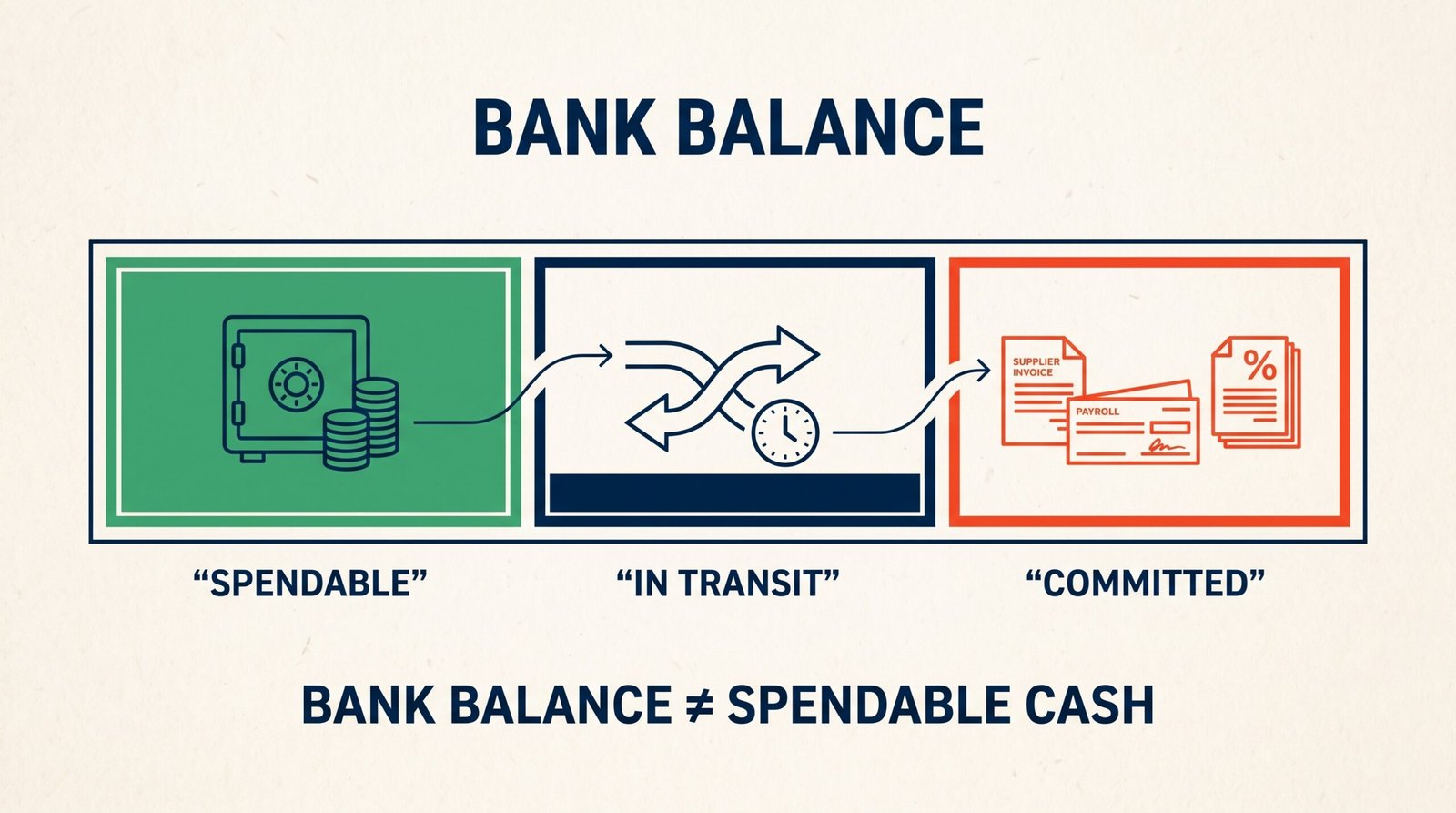
- Money already spoken for. Not every dollar in the bank is free to spend. Some may be committed to sales tax collected from customers, which state tax authorities describe as held in trust for the state, or to payroll taxes and income tax payments.
None of these signals a problem on its own. They’re reminders that a bank balance isn’t the same as spendable cash.
How to Tell Whether Growth Is Absorbing Your Cash
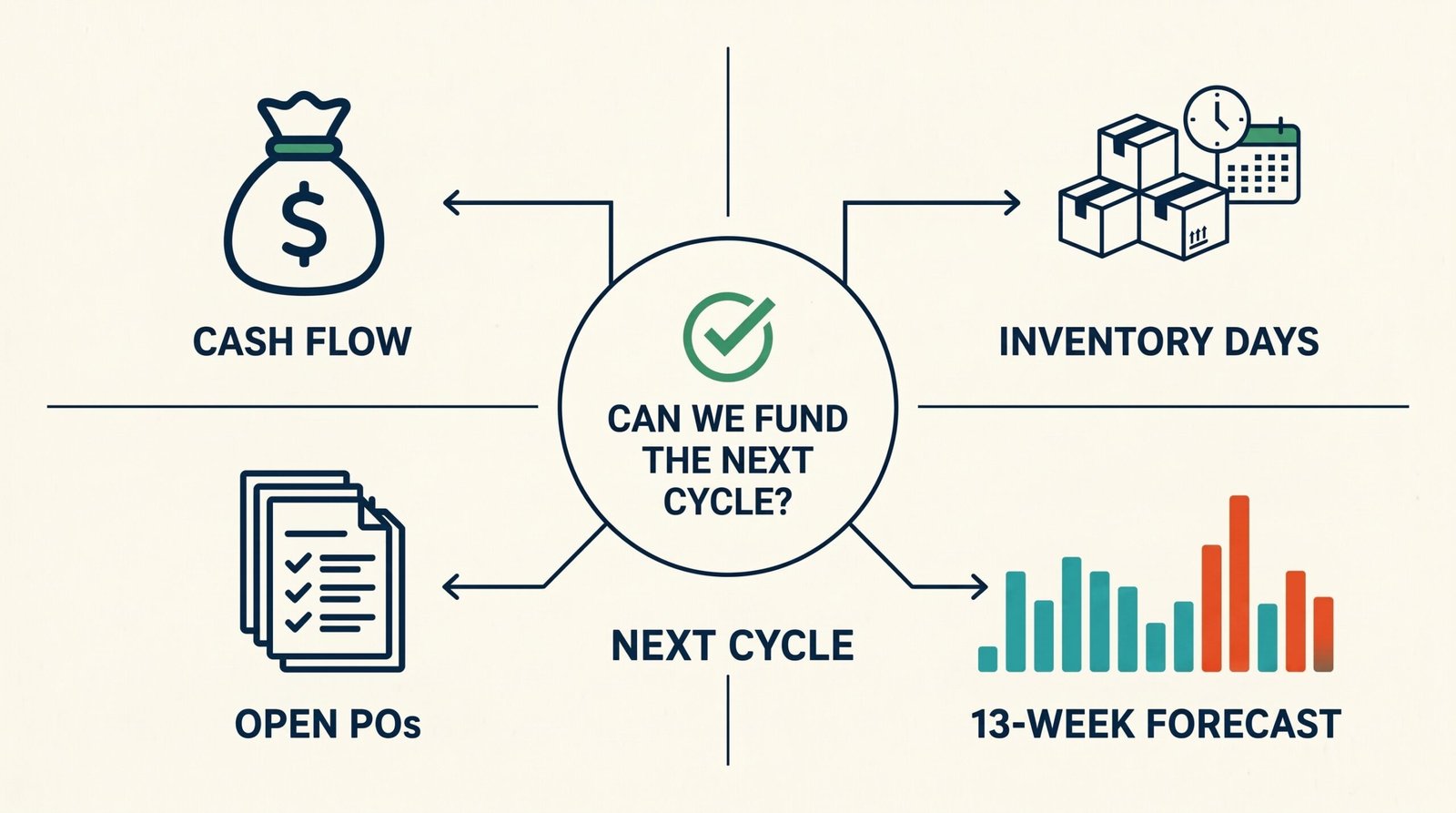
If the mechanism is right, a founder should be able to see it. Four tools cover most of what the profit report can’t show.
Did operations produce cash or absorb it? The cash flow statement, and operating cash flow in particular, answers this. It also separates out things like debt repayment, so you can tell whether the pressure comes from running the business or from other uses of cash. You don’t need to master the whole statement. You’re looking for whether profit is turning into stock rather than spendable money.
How long is cash sitting in stock? Days of inventory gives you a rough sense of how long stock is sitting before it sells, while inventory aging shows how long particular products have been on the shelf. A rising number means cash is staying in stock longer. Aging shows whether that cash is in products that are moving or products that aren’t, which a single blended average can hide.
What future cash is already spoken for? The profit report doesn’t show the deposit due next month or the balance payment on an order still in production. Open purchase orders and supplier commitments do. Shopify’s purchase order tools can record the supplier, cost and payment terms, which gives you a place to start.
Can the business meet its known obligations over the next quarter? A 13-week cash forecast lays out week by week what’s expected to come in and go out: supplier payments, payroll, taxes, payouts, debt payments and inventory commitments, all on one timeline. It’s a way of finding out ahead of time when the loop will be tight.
Margin can tell you whether a product or a sale makes money. It can’t tell you whether you can fund the next round of stock, and these four tools can. Wholesale brands can add two more: an aging report on what customers owe them, and the average number of days customers take to pay.
The cash conversion cycle ties them together, and you don’t need its formula. It’s enough to notice whether the number of days your cash is out is getting longer or shorter as the business grows.
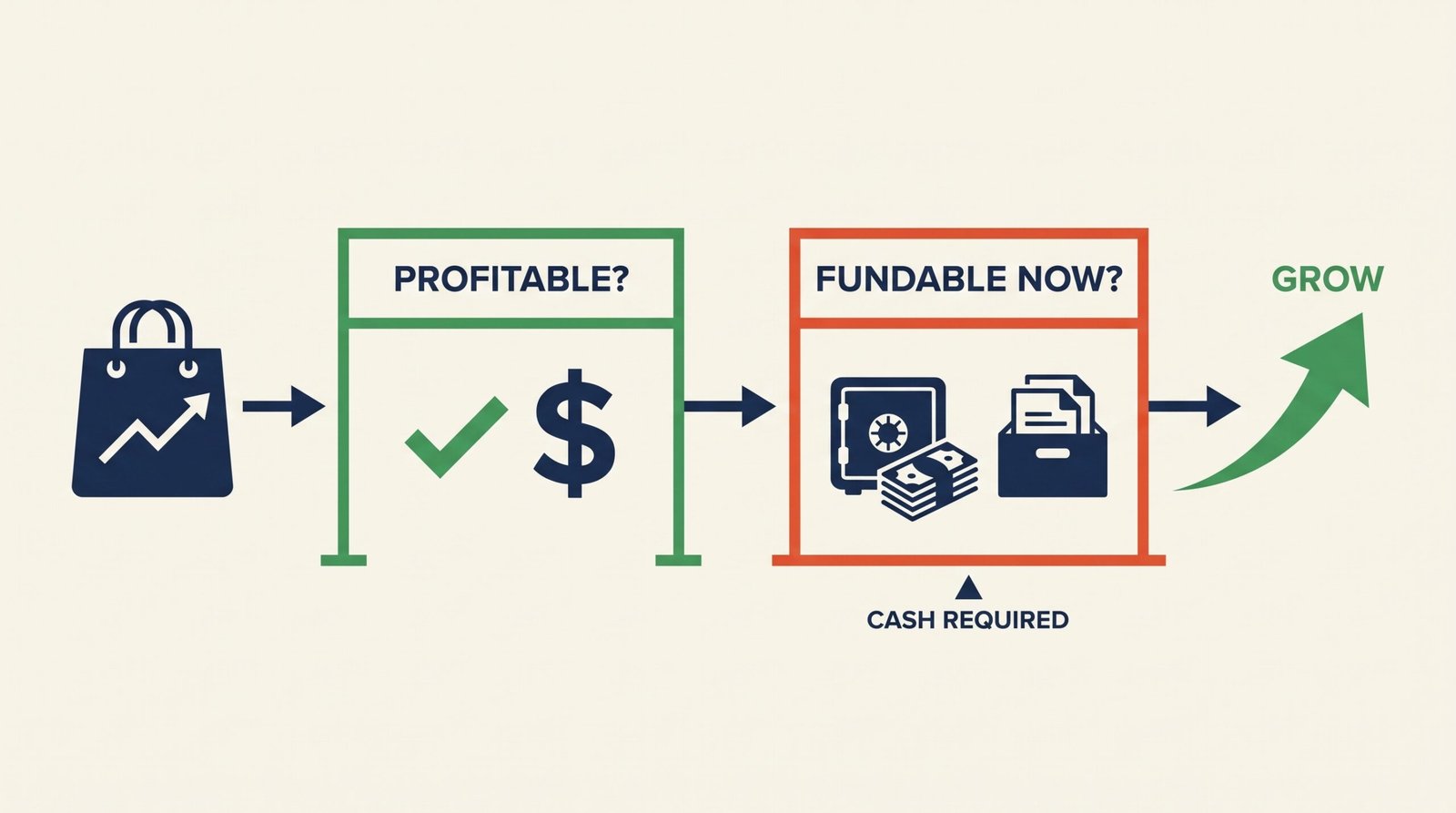
Profit Tells You Whether Growth Works. Cash Tells You Whether You Can Fund It.
The same numbers change how a founder looks at the next decision. Profit shows whether an activity is worth doing, and the cash view shows whether you can afford to do it now.
The next inventory order. A product with strong margins looks like an easy reorder. Before placing the order, it helps to know how much cash is already committed to open purchase orders, and when the last cycle will return it.
A larger minimum order quantity. A bigger order can lower the cost per unit, which can be a real benefit. The cost is that more cash stays in stock, so the question becomes how much extra, and for how long.
Higher ad spend. When return on ad spend looks healthy, scaling is tempting. But more spend can create another cash requirement before the extra sales pay back, and more sales also need more inventory. It’s worth asking how much additional stock and acquisition cash the higher volume needs before the cycle returns it.
An owner distribution. “We made $X this quarter” is a fact about profit. It doesn’t say how much of that cash the next inventory cycle and the known obligations will need. That portion is the part to keep in the business.
Launching another SKU or expanding into wholesale follows the same logic. Each begins with an inventory commitment or a longer wait for cash, so each looks profitable on paper before it looks fundable in the bank. None of this argues against growth. It adds a second question to the first.
The Question Behind the Question
At the start, the founder asked: Why do we have no cash if we’re profitable?
The profit was real. The cash went into stock, deposits, freight and obligations, and it comes back only as the loop turns. Growth makes the loop larger.
Growth is funded before it is earned. Profit tells you whether the activity creates economic value, and cash visibility tells you whether the company can finance the operating cycle needed to capture it.
So for a growing Shopify brand, “Are we profitable?” is only the first question. The next one is this: how much cash does each new level of growth require before that cash comes back?